Quick answer
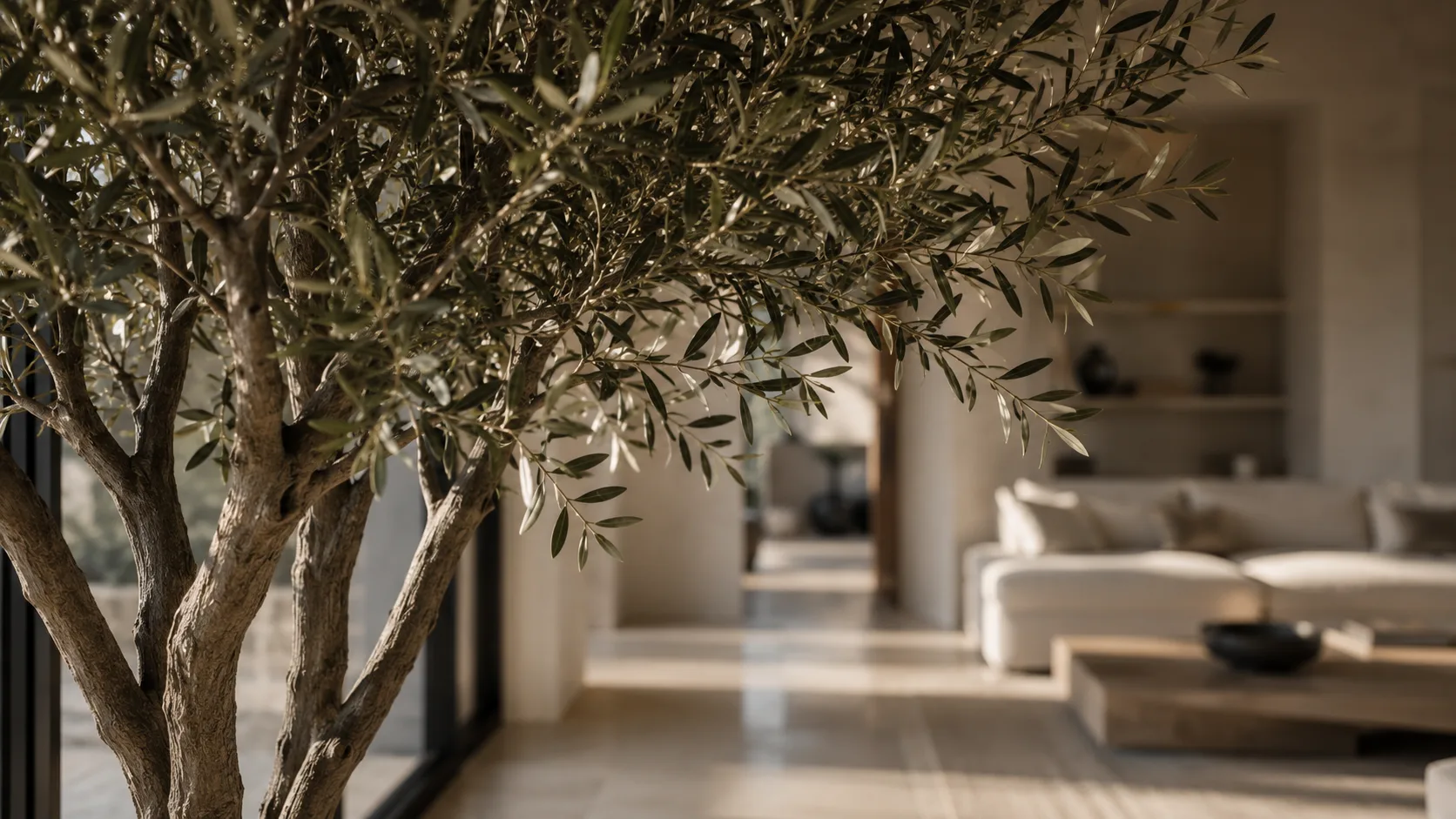
Realism comes down to detail, not size — varied leaf colour and shape rather than one repeated mould, natural branching instead of symmetrical spokes, a matte real-touch finish rather than shine, and a trunk with genuine weight. Cheaper plants cut corners on all four; premium ones don't.
From across a room, most artificial plants look convincing. It's only up close — or after living with one for a few months — that the difference between a well-made piece and a budget one becomes obvious.
That difference rarely comes down to a single feature. It's the accumulation of small decisions: how the leaves were moulded, how the branches were assembled, what the trunk is made from, how the surface was finished. Understanding what to look for makes it far easier to choose a piece that holds up to daily scrutiny, not just a photograph.
Leaf shape, colour and texture
The single biggest tell is repetition. Budget plants are built from one or two leaf moulds, cast hundreds of times and attached in a regular pattern — the eye picks up on that uniformity almost instantly, even without consciously noticing why. A realistic plant uses several leaf variations in slightly different sizes, shades and states of growth, the way an actual plant would.
Colour matters as much as shape. Real foliage is never one flat green — it shifts between yellow-green new growth, deeper mature leaves and the occasional muted or browning edge. Premium pieces reproduce that variation deliberately. Budget ones are usually moulded and dyed in a single uniform tone.
Branch and trunk construction
Cheap artificial trees are often built around a straight, symmetrical central pole with branches attached at even, repeating intervals — efficient to manufacture, but nothing like how a tree actually grows. A realistic piece is hand-shaped, with branches at irregular heights and angles, some thicker, some sparse, echoing the asymmetry of natural growth.
The trunk itself is the clearest giveaway. A hollow plastic trunk feels light and looks flat under any direct light. Better pieces use natural or naturalistic trunks — genuine wood, or a cast replica with real bark texture and colour variation — that carry visible weight and catch light the way bark actually does.
Real-touch materials over hard plastic
Material choice changes how a leaf behaves under light, not just how it feels to the hand. Hard PVC leaves tend to be stiff, uniformly glossy and reflective — under a window or lamp, they read as plastic even from a distance. Real-touch polyethylene and blended silk-style leaves are softer, hold a slight natural sheen rather than a hard shine, and move more like real foliage when brushed.
This matters more than it sounds — most people never touch a plant they walk past daily, but they do see it under changing light throughout the day. Material is what determines whether that light reads as convincing or artificial.
Finish: matte over glossy
Glossy leaves are one of the fastest ways to spot a lower-quality plant. Real foliage has a soft, low sheen — never a uniform shine. Manufacturers use a matte or satin coating on premium pieces specifically to avoid the plastic reflectiveness that comes from an unfinished mould. It's a small production step, and one of the easiest to skip on a budget line.
Weight, base and stability
Pick up a well-made artificial tree and it feels closer to furniture than to a toy. That weight usually comes from a weighted base or a genuine wood trunk section — both add cost, but both are what stop a tall piece from feeling flimsy or tipping in a draught. A lightweight, hollow-feeling trunk is one of the clearest signs of corners cut elsewhere in construction.
Scale and proportion
Even a well-constructed plant can look wrong if the proportions are off — a canopy that's too dense for the trunk, or leaves sized for a smaller variety scaled up without adjustment. Realistic pieces are modelled on the actual growth habit of the plant or tree they're replicating, not simply stretched to a taller size.
At a glance
| Detail | Premium | Budget |
|---|---|---|
| Leaf variation | Multiple moulds, varied colour | One mould, repeated |
| Branch structure | Hand-shaped, irregular | Symmetrical, machine-spaced |
| Trunk | Natural wood or cast bark texture | Hollow plastic |
| Leaf material | Real-touch, matte finish | Hard PVC, glossy |
| Base weight | Weighted, stable | Light, prone to tipping |
| UV stability | Colour holds in sunlight | Fades and discolours |
Signs to look for before buying:
- Leaf colour and shape vary across the canopy, not repeated identically
- The trunk has visible texture and carries genuine weight
- Branches sit at irregular heights and angles
- The surface finish is matte, not glossy or reflective
- Materials are described as real-touch, UV-stabilised, or similar
- The base feels stable and substantial, not hollow
A few things people ask
What makes an artificial plant look realistic?
Realism comes from leaf-level detail — varied colour and shape rather than a single repeated mould — combined with natural branch structure, a real-touch matte finish and a trunk with genuine weight and texture.
Why do some artificial plants look obviously fake?
Usually a combination of uniform, glossy leaves, a lightweight hollow trunk and symmetrical branching — all signs of a mould-based, mass-produced piece rather than one built and shaped by hand.
Does the material affect how realistic a plant looks?
Yes. Real-touch polyethylene and blended silk-style leaves hold colour and light differently to hard PVC, which tends to look shiny and one-dimensional under natural light.
Are more expensive artificial plants actually more realistic?
Generally, yes — cost reflects labour. Hand-shaped branches, individually attached leaves and natural trunks all take longer to produce than a moulded, mass-manufactured piece, and that time shows in the result.
Do realistic artificial plants fade in sunlight?
Premium pieces use UV-stabilised materials designed to hold their colour in direct light. Budget plastics fade and discolour far more quickly, especially near windows.
How can I tell if a plant is high quality before buying?
Look closely at product photography for leaf variation and matte texture, check whether the trunk looks weighted and textured rather than hollow, and read the materials description for UV-stabilised or real-touch finishes.
Realism isn't a single feature — it's the sum of leaf, branch, trunk and finish decisions made long before a piece reaches a room.
Every piece in our Mediterranean Living and Sculptural Greenery collections is built to this standard — see our large faux olive tree guide for how these details apply to a specific statement piece, or read real vs artificial olive trees for an honest comparison.