Quick answer
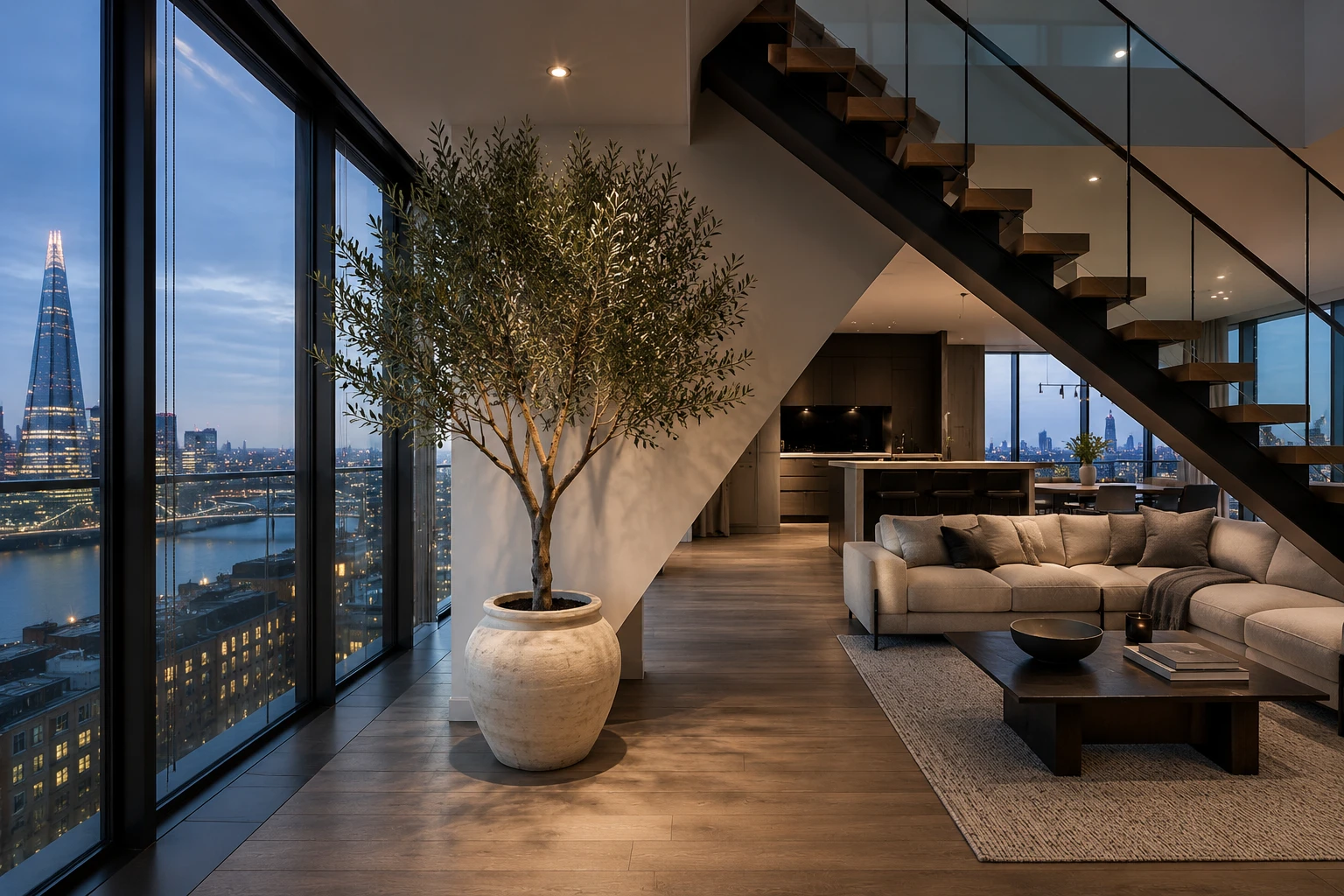
For most living rooms, a realistic artificial olive tree between 6ft and 7ft in a natural terracotta or stone planter. Look for matte, varied-tone leaves, a slightly irregular branch structure and a trunk with visible texture. These are the qualities that hold up at close range in a residential interior.
Olive trees work beautifully in living rooms because they bring height, softness and a quiet Mediterranean character without making the space feel overly styled.
A well-chosen artificial olive tree can do the same thing, with one important advantage: it can be placed where the room needs it, not only where natural light allows it.
That matters in a living room. The best corner for visual balance is not always the brightest corner. Sometimes the tree belongs beside a sofa, behind an armchair, near a console table, or in a quiet empty space that needs height and texture. A realistic artificial olive tree gives you that freedom.
The question is not simply which artificial olive tree looks good online. It is which one will feel considered, natural and proportionate once it is in the room.
What to look for
The best artificial olive tree for a living room should feel like part of the interior, not an accessory added afterwards.
Quality comes down to three things: branch structure, leaf variation and scale. A poor-quality faux olive tree often looks too symmetrical — leaves too uniform, trunk too smooth, shape too manufactured. In a living room, where the tree is usually seen up close, those details are immediately apparent.
A good artificial olive tree has a slightly irregular silhouette. The branches move naturally. The leaves vary in tone — soft gray-green rather than bright plastic green. The trunk has texture and enough visual weight to balance the foliage above it.
The goal is not perfection. In fact, perfection is usually what makes an artificial tree look artificial.
Choosing the right height
Height guide
| Height | Best for |
|---|---|
| 5ft | Smaller rooms, apartments, low ceilings, beside furniture or a reading chair |
| 6ft | Most living rooms — a strong all-round choice |
| 7ft | Larger rooms, high ceilings, open-plan spaces, statement corners |
| 8ft+ | Double-height spaces, hospitality settings and dramatic architectural interiors |
If the tree is too small it reads as decorative. If it is too large it dominates. The right choice usually feels as though it belongs to the architecture of the space.
Where to place it
Before choosing, decide where the tree will go. Placement shapes everything — the height you need, the width of the canopy, the weight of the base.
Beside the sofa. This softens the sofa line and adds height to the room. It works especially well when the sofa is low, neutral or linen-covered.
In an empty corner. An olive tree can make an unused corner feel intentional. This is one of the most effective uses of a large artificial olive tree — a single piece that gives a previously dead space purpose and atmosphere.
Near a window. Even though it does not need light, placing an artificial olive tree near natural light makes it feel more at home in the room. The branches can cast soft shadows across the wall or floor.
Beside a console table. A calm, considered transition into the living area — particularly effective alongside ceramics, books or a stone lamp.
Behind an accent chair. This adds depth to a reading corner without crowding the space.
The tree should add atmosphere, not become an obstacle. Leave room around it to breathe.
The planter
The planter can make or break the look. Most artificial olive trees arrive in a basic nursery pot — that is normal, but it should usually be placed inside a more substantial vessel.
Aged terracotta, warm stone, textured ceramic, concrete or a woven basket all suit the Mediterranean character of the tree. Avoid anything too glossy or decorative. The planter should feel quiet and natural, not like a statement in its own right.
The pot should visually anchor the tree. Too small and the whole piece looks temporary. A wider, heavier-looking planter makes the tree feel more permanent and considered — and, usually, more expensive.
Realism at close range
Because living rooms are close-view spaces, realism matters more than in a hallway, lobby or retail interior. The tree will be seen from the sofa, from a chair, from the doorway. It needs to hold up from all of those angles.
The best artificial olive trees use foliage with subtle variation — some leaves lighter, some darker, some slightly turned or angled differently. The branches are not identical. The tree looks shaped by growth, not assembled by formula.
When reviewing product photography, look at close-up images rather than only full-room lifestyle shots. Matte leaves rather than shiny. Textured trunk. A slightly irregular silhouette that reads as natural from more than one angle. If it passes those tests in photographs, it is likely to hold up in a real room.
Real or artificial
A real olive tree can be beautiful in a bright living room with strong natural light. But many living rooms are not ideal — too shaded, too warm in winter, too far from direct sun. An artificial olive tree gives the same visual effect without the dependency on conditions.
If you are still weighing up both options, our guide to real vs artificial olive trees covers the practical differences in detail.
The right choice
For most living rooms, a tree between 6ft and 7ft in a substantial natural planter is the right starting point. Tall enough to feel architectural. Proportionate enough to sit beside furniture without overwhelming it.
Go taller for high ceilings or generous floor area. Choose a slimmer tree rather than a shorter one if space is tight — a tall, narrow olive tree reads as more intentional than a small, full one.
The best artificial olive tree for a living room is not necessarily the biggest or the fullest. It is the one that feels calm, proportionate and believable in the space. It should not shout for attention. It should make the room feel more complete.
A few things people ask
What size artificial olive tree is best for a living room?
For most living rooms, a tree between 6ft and 7ft works well. This is tall enough to feel architectural without overwhelming the space. Rooms with high ceilings or generous floor area can carry a larger tree. If space is tight, choose a slimmer tree rather than a shorter one — a tall, narrow olive tree reads as more intentional than a small, full one.
Where should I place an artificial olive tree in a living room?
The most effective placements are beside the sofa, in an empty corner, near a window, beside a console table or behind an accent chair. Avoid positioning the tree where it blocks natural movement through the room. It should add atmosphere and height, not become an obstacle.
How can I tell if an artificial olive tree is good quality?
Look for matte, varied-tone leaves rather than uniform glossy ones. The silhouette should be slightly irregular — not perfectly symmetrical. The trunk should have visible texture. In product photography, check close-up images rather than only full-room lifestyle shots. A tree that looks natural from multiple angles in photographs is likely to hold up in a real room.
What planter works best with an artificial olive tree in a living room?
Aged terracotta, warm stone, textured ceramic, concrete or woven baskets all suit the Mediterranean character of an olive tree. Avoid anything too glossy or decorative. The planter should visually anchor the tree — too small and the whole piece looks temporary. A wider, heavier-looking planter makes the tree feel more permanent and considered.
Can an artificial olive tree look good in a room without natural light?
Yes — this is one of the key advantages of a well-made artificial olive tree. Unlike a real olive tree, which needs several hours of direct sun to survive indoors, an artificial one can be placed wherever the room requires it, including darker corners, north-facing rooms or spaces away from windows. The visual effect remains the same regardless of light conditions.
See the Casa Verdant Olive Tree collection, or read more about materials and construction. For a fuller picture of the decision between real and artificial, our comparison guide covers the key differences.