Quick answer
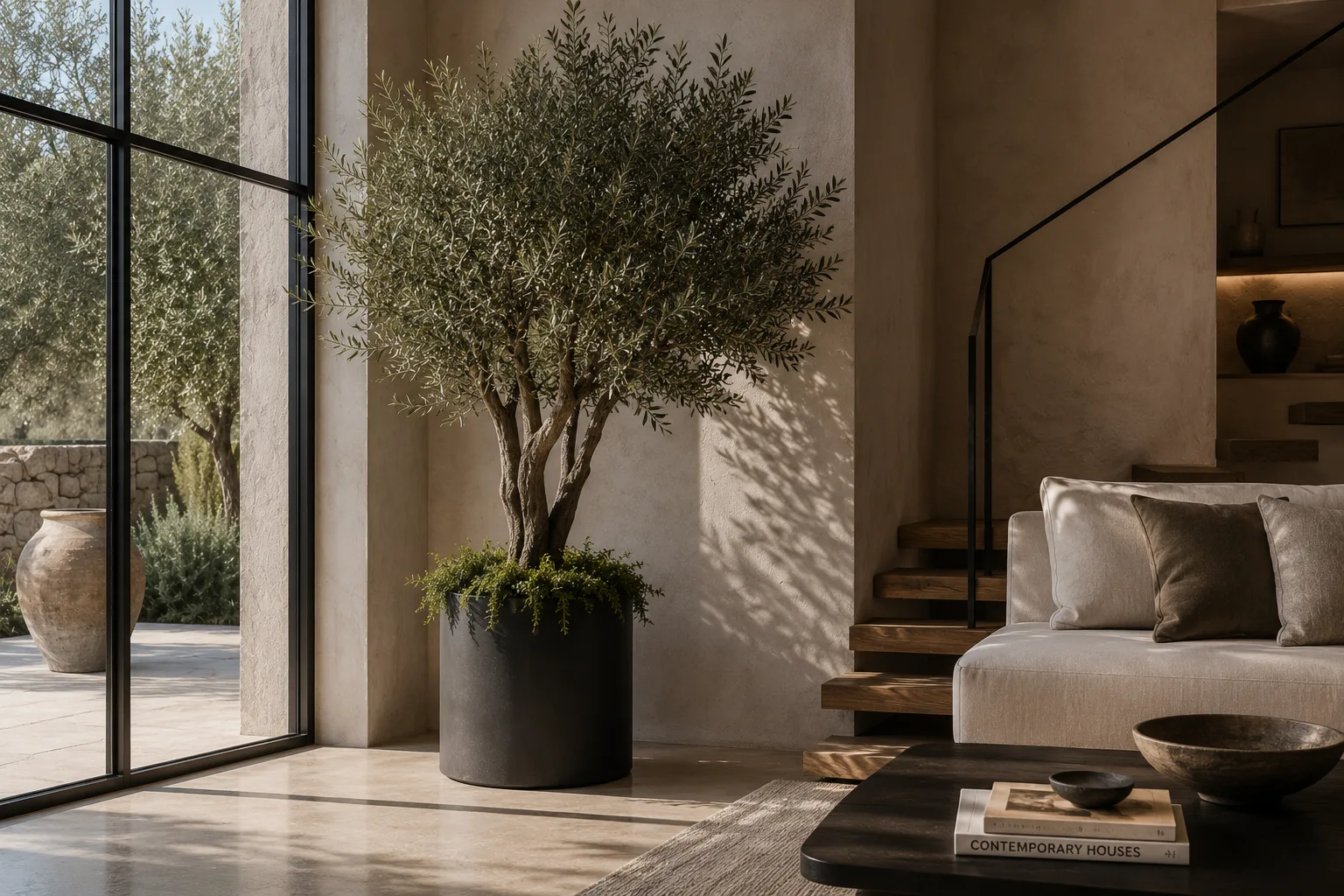
For most homes, a 6-7ft artificial olive tree strikes the right balance of scale and flexibility — smaller spaces suit 5-6ft, while double-height rooms and commercial interiors can carry 8-10ft. Pair it with a planter that feels substantial — matte black, aged terracotta or natural stone — and give it enough clear space to read as a single architectural piece rather than a corner filler.
Few interior pieces change the character of a room quite like a large olive tree. Positioned in a double-height entrance hall, beside floor-to-ceiling glazing, or anchoring a contemporary living room, it brings softness, scale and architectural interest that few decorative objects can match.
For many homeowners and designers, keeping a mature living olive tree indoors is genuinely difficult — light levels, watering schedules and seasonal leaf drop all work against it. Today's premium artificial olive trees are realistic enough that they've become one of the most requested statement pieces in luxury residential and hospitality interiors.
This guide covers how to choose the right size, planter and placement for an installation that reads as considered rather than decorative.
Why olive trees never go out of style
Olive trees have been admired for thousands of years. Their twisted trunks, grey-green foliage and sculptural form suit almost every design style, and unlike a tropical plant that can dominate a room, an olive tree adds texture without overwhelming the space. They work as well in a contemporary home or a Californian-inspired interior as they do in a Mediterranean-style property, a boutique hotel, a restaurant or a reception area — the result reads as understated rather than dramatic, which is exactly what gives it staying power.
Why choose an artificial olive tree
A well-made artificial olive tree combines realistic craftsmanship with everyday practicality. There's no watering, no leaf drop, no seasonal change and nothing to treat for pests — just a consistent appearance, year after year, including in rooms with little or no natural light. For holiday homes, second residences and commercial properties in particular, that reliability matters more than it might in a home lived in daily.
Choosing the right size
Getting the height right matters more than choosing the tree itself — too small and it disappears into the room, too large and it dominates it.
6ft and under suits apartments, bedrooms, home offices and dining rooms, adding a subtle botanical feature without overwhelming the space.
6-7ft is the most versatile size, and usually the best choice for standard American ceiling heights — it works in living rooms, family rooms, kitchens and open-plan spaces.
8-10ft is built for larger interiors: double-height spaces, entrance halls, luxury homes, boutique hotels and commercial reception areas, where the tree becomes an architectural feature rather than an accessory.
Choosing the right planter
The planter matters as much as the tree — the best interiors rely on contrast between the organic shape of the foliage and the simplicity of the container. Matte black cylinders suit contemporary interiors — concrete floors, black steel windows, walnut cabinetry. Aged terracotta adds warmth, and works best in organic modern or Californian-inspired homes. Natural limestone or textured stone planters bring a quieter luxury that complements neutral interiors, and bronze or metal finishes suit hospitality environments looking for a more refined, contemporary edge.
Where to place a large artificial olive tree
The best locations give the tree room to breathe — avoid squeezing it into an empty corner simply because the space is available. Think of it as a piece of furniture, not an afterthought.
Beside floor-to-ceiling windows, natural light enhances the realistic colouring of the leaves, even though the tree itself doesn't need it. In an entrance hall, it creates an immediate focal point for anyone arriving. In a living room, position it beside a sofa or reading chair to soften the architectural lines of the room. On a stair landing, it fills a tall vertical space that would otherwise feel empty. In a dining area, it adds warmth without interrupting sightlines across the table, and in a home office, it makes a calming backdrop for video calls.
Leave at least 12-18 inches of clear space around the planter — crowding a large tree with side tables or decorative accessories reduces its visual impact. Treat it as a sculptural object, not simply another piece of décor.
Styling around an olive tree
The most successful interiors use restraint, letting the tree read as the hero rather than surrounding it with several smaller plants. Pair it instead with high-quality natural materials — linen upholstery, a travertine coffee table, walnut furniture, limestone flooring, a textured wool rug, handmade ceramics. These reinforce the same calm, organic character without competing for attention.
What makes a premium artificial olive tree
Not all artificial trees are made equally. Budget pieces tend to reveal themselves through shiny leaves, repetitive branching and a lightweight trunk. Look instead for natural multi-stem construction, realistic bark texture, varied leaf colour, fine branch detailing, a dense but natural canopy and hand-shaped foliage over a heavy internal structure. A genuinely good tree looks convincing from every angle, not just in a photograph.
Artificial vs real olive tree
| Factor | Artificial Olive Tree | Real Olive Tree |
|---|---|---|
| Watering | None | Regular |
| Sunlight | Not required | Essential |
| Maintenance | Minimal | Ongoing |
| Leaf drop | None | Seasonal |
| Pests | None | Possible |
| Appearance | Consistent | Changes with conditions |
| Suitable for dark rooms | Yes | No |
For most interiors — particularly those with limited natural light — a premium artificial olive tree delivers the same visual effect with none of the upkeep.
Common mistakes to avoid:
- Choosing a planter that's too small
- Positioning the tree directly against a wall
- Using more than one feature tree in the same room
- Pairing it with brightly coloured accessories
- Choosing a glossy plastic container
- Overfilling the room with additional plants
Less is almost always more.
Checklist before buying:
- What is the ceiling height?
- Where will the main viewing angle be?
- Does the planter complement the architecture?
- Will the tree have enough visual space around it?
- Is the style contemporary, organic or classic?
- Does the size balance the rest of the furniture?
A few things people ask
What is the best size artificial olive tree for a living room?
6-7ft gives the best balance of scale and flexibility for most homes.
Do artificial olive trees look realistic?
Premium pieces use natural trunks, individually shaped branches and lifelike foliage close enough to a mature olive tree that most people won't look twice.
Can I use one in a dark room?
Yes — unlike a living tree, it doesn't need natural light, which makes it well suited to hallways, offices and other low-light spaces.
Which planter works best?
Matte black, textured stone and aged terracotta are the most popular choices, since they complement the tree without drawing attention away from it.
How do I clean it?
A soft microfibre cloth or the occasional gentle dusting is usually all it needs.
Are they suitable for commercial spaces?
Yes — they're widely used in hotels, restaurants, offices and retail spaces because they hold their appearance with almost no maintenance.
A large artificial olive tree is more than a decorative accessory — it's an architectural feature that brings warmth, texture and permanence to a room, in much the same way a carefully chosen piece of furniture or artwork does.
At Casa Verdant, our Mediterranean Living collection is built around pieces like this — see our guide to choosing a large artificial tree for more on scale and placement, or read why olive trees define Mediterranean interiors for the design thinking behind them.