Quick answer
A real olive tree thrives with 6+ hours of direct sun, consistent care and patience. An artificial olive tree suits any placement, requires no maintenance and holds its character year-round. For most modern interiors — particularly those without strong natural light, or commercial and hospitality spaces — a well-made artificial olive tree is the more reliable choice.
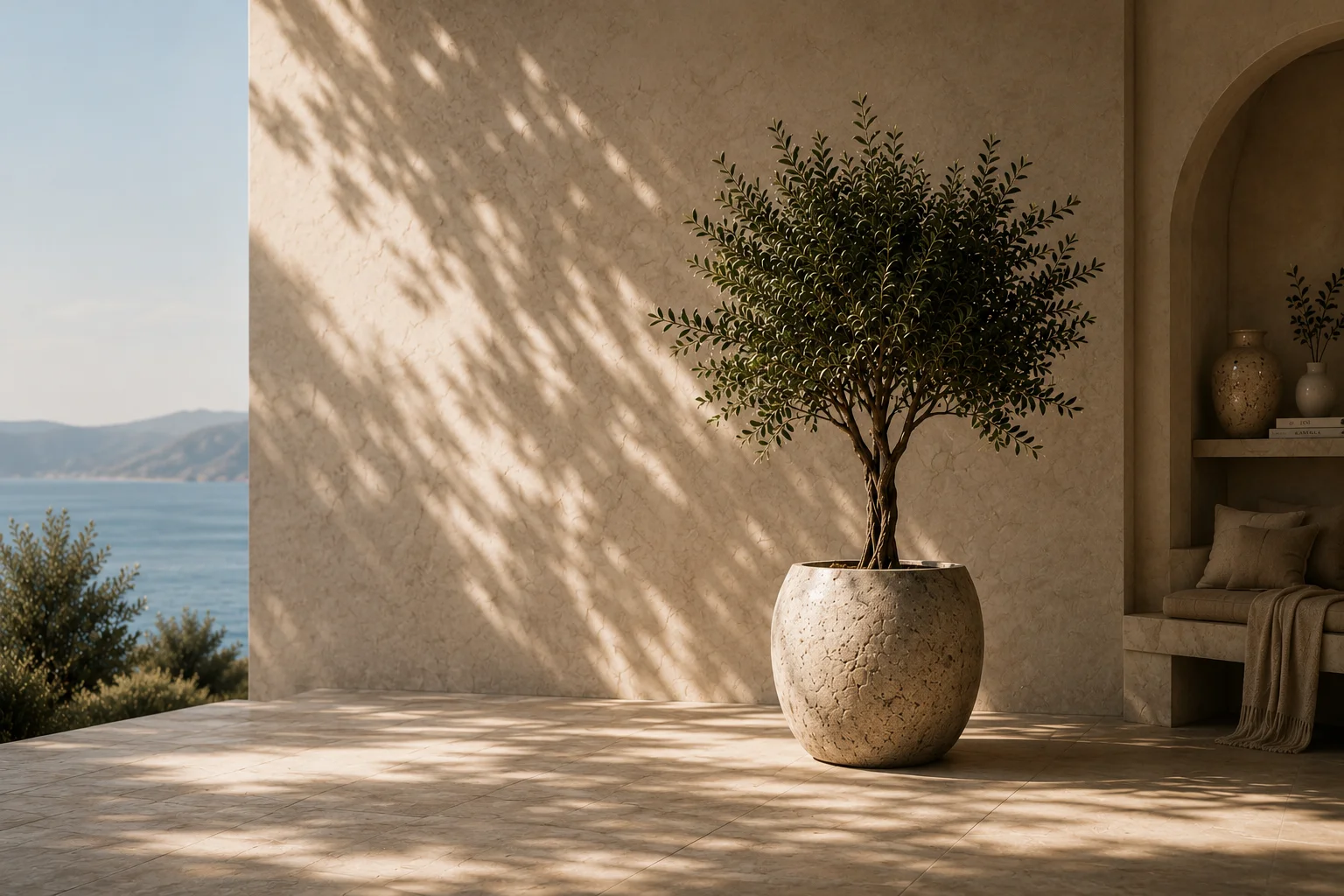
Olive trees have a way of changing a room without trying too hard. Their slim, silvery leaves, sculptural branches and quiet Mediterranean character bring something to an interior that very few plants can — a sense of calm, age and considered restraint.
Which is why so many people, when styling a living room, an entryway or a hospitality space, come back to the same question: real olive tree, or artificial?
It is a reasonable thing to think through carefully. Both can be right. The answer depends on the space, the light, the level of care you want and what you are actually asking the tree to do.
The case for a real olive tree
A living olive tree has a character that is genuinely hard to replicate. No two grow in exactly the same way. The movement of the branches, the variation in the leaves, the way it responds over time — a real olive tree is a living thing, and that comes with its own kind of presence.
In the right conditions, it can be exceptional. A conservatory, a bright south-facing room, a garden room with good ventilation — these are environments where a real olive tree can thrive and age beautifully. For people who enjoy plant care, who want to watch new growth appear through the seasons, who have the light and the patience, a real tree is deeply rewarding.
The honest difficulty is that real olive trees are demanding guests indoors. They need several hours of direct sun. They dislike inconsistent watering — too much or too little — and they respond to stress by dropping leaves, often when you least want them to. They can be moved only so far before they begin to decline. In darker rooms, apartments without strong natural light or commercial spaces where maintenance is limited, a real olive tree tends to deteriorate rather than settle.
The case for an artificial olive tree
The best artificial olive trees today bear very little resemblance to the plastic plants of twenty years ago. A well-made piece will have varied leaf tones, natural branch structure, realistic bark texture and a shape that feels designed rather than imitated.
The practical advantages are significant.
An artificial olive tree can be placed exactly where the room needs it — not where the light happens to fall. It can go in a shaded hallway, a hotel lobby, a bathroom, a restaurant corner or an office. It does not drop leaves. It does not need watering, repotting or seasonal care. It looks the same in January as it does in June.
For interiors where the tree is primarily a design decision — where what matters is height, texture, atmosphere and permanence — this consistency is not a compromise. It is the point.
Commercial and hospitality environments are where artificial trees often make the most sense. Hotels, restaurants and retail spaces need greenery that performs reliably every day, requires no ongoing maintenance and, in many cases, meets fire safety requirements. A premium artificial olive tree, made to the right specifications, can do all of that.
The distinction that matters is quality. A poorly made artificial olive tree will read as false immediately — too uniform, too shiny, too symmetrical. A carefully selected one, made from good materials, will add to a room rather than undermine it.
At a glance
| Factor | Real olive tree | Artificial olive tree |
|---|---|---|
| Light needed | 6+ hours direct sun daily | None — place anywhere |
| Maintenance | Regular watering, pruning, feeding | Occasional dusting only |
| Leaf drop | Yes — especially under stress | None |
| Longevity | Years, with consistent care | Many years, no degradation |
| Placement | Near windows, bright rooms only | Any room, any light condition |
| Outdoor use | Yes, in suitable climates | Covered outdoor spaces with UV-rated tree |
| Commercial use | Possible, requires maintenance | Ideal — low maintenance, fire rated options available |
| Allergy risk | Pollen in season | None |
| Upfront cost | Lower for small sizes | Higher for premium quality |
| Long-term cost | Ongoing: soil, feed, replacement | One-time investment |
Choosing between them
The real question is not which is more authentic. It is what you are asking the tree to do.
A real olive tree is the right choice when the conditions are genuinely suitable — good natural light, a committed care routine, a space that can accommodate a living plant through its seasonal changes. It rewards patience and attention.
An artificial olive tree is the right choice when the tree is being used as a design feature: a permanent element of the room that should look considered on any given day, in any light, without ongoing intervention. It suits interiors where placement matters more than horticulture, and spaces — commercial or residential — where longevity and reliability are part of the brief.
The design effect of a well-placed, well-made olive tree is the same either way. One requires care to maintain it. The other simply requires a good eye to choose it.
A few things people ask
How long does an artificial olive tree last?
A premium artificial olive tree, made from quality materials and placed correctly, can last many years without deterioration. UV-stable polymers and properly treated finishes maintain their appearance far longer than cheaper alternatives. Trees built to commercial standards are designed to hold their character under daily use.
Can an artificial olive tree go outside?
It depends on the materials. A UV-resistant tree can work well in a covered outdoor space — a terrace, loggia or sheltered courtyard — where it gets indirect light and limited weather exposure. It should not be left in direct rain or strong wind without shelter. For any outdoor placement, check the UV and weathering specifications carefully before buying.
Do artificial olive trees look realistic?
The best ones do. What separates a convincing artificial olive tree from an unconvincing one is the detail: varied leaf tones (olive trees have two-tone leaves — silver-green on one side, darker on the other), irregular branch structure, natural taper in the trunk. A well-made tree has imperfections — no two branches identical, no leaves uniformly spaced. That irregularity is what makes it read as real.
What size olive tree suits a living room?
For most living rooms, a tree between 150cm and 180cm works well — tall enough to read as a statement without overwhelming the space. Rooms with higher ceilings can carry 200cm or more. The key is proportion: the canopy should not extend wider than the seating group it sits beside.
Are artificial olive trees safe around pets?
Generally yes. Artificial olive trees contain no toxic materials that would harm pets if touched or brushed against. The main consideration is stability — a large tree in a lightweight pot can be knocked over. A weighted base or appropriately sized planter reduces that risk. Real olive trees are also considered non-toxic to cats and dogs, though ingestion of any plant material in quantity can cause mild stomach upset.
How do you clean an artificial olive tree?
Dust the leaves occasionally with a soft cloth or a gentle burst of compressed air. For a more thorough clean, wipe individual branches and leaves with a lightly damp cloth. Avoid harsh cleaning products, which can strip the finish. An artificial olive tree does not need cleaning often — once every few months is usually sufficient for residential use.
Casa Verdant olive trees are carefully selected for realistic branch structure, natural leaf variation and a calm Mediterranean character suited to residential and commercial interiors. See the Olive Tree collection or read more about materials and construction.