Quick answer
Luxury hotels use premium artificial greenery because it delivers unfailing visual consistency, removes daily watering and maintenance, and lets designers place statement trees anywhere — including corridors, spas and rooms with no natural light — without compromising on realism.
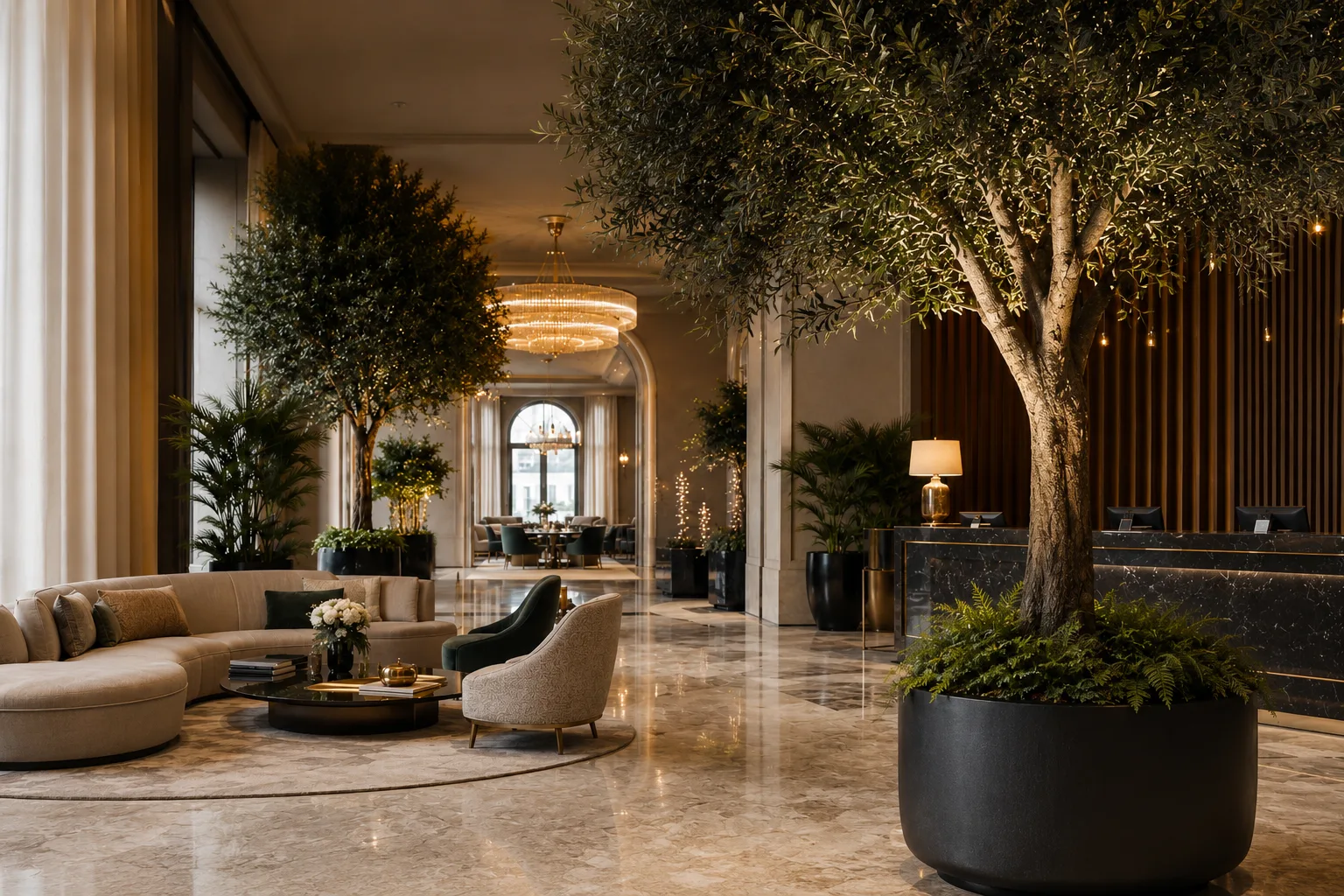
Walk into almost any five-star hotel and you'll notice something before you've even reached reception. A mature olive tree catching the afternoon light. A sculptural ficus anchoring the lobby. Cascading greenery softening a restaurant, or a dramatic living wall welcoming guests into the spa.
What many guests don't realise is that a meaningful share of this planting isn't alive.
Across luxury hospitality, premium artificial greenery has become an essential design tool — not because hotels want to imitate nature, but because they want complete control over how their spaces look, every day of the year.
Today's commercial-grade trees and plants bear little resemblance to the decor of previous decades. High-end installations are individually assembled, botanically accurate, and built specifically for prestigious commercial interiors. For luxury hotels, artificial greenery offers something real plants often cannot: consistency, flexibility and reliability, without giving up visual impact.
The first impression starts in the lobby
Every hotel has one chance to make a first impression. Long before a guest experiences the rooms, the restaurant or the spa, they form an opinion within seconds of entering reception.
This is why hotel designers so often turn to statement planting to create a sense of arrival — a mature olive tree, a large ficus, an elegant run of oversized planters. A dramatic botanical installation communicates calm, luxury and permanence almost instantly.
Unlike seasonal flowers that need constant replacing, premium artificial trees stay immaculate every day of the year — no dropped leaves, no browning foliage, no inconsistent growth, no maintenance interruptions to work around. For hotels welcoming hundreds, sometimes thousands, of guests each week, that visual consistency is part of the brand experience itself.
Consistency through every season
Luxury hospitality relies on predictability. Guests expect the same standard whether they arrive in January or August.
Real plants are living organisms, and they respond to changing light, temperature, humidity and watering schedules — even professionally maintained displays can suffer yellowing leaves, uneven growth, pests or seasonal decline, particularly during a hotel's busiest weeks when watering routines are hardest to keep to.
Artificial greenery removes those variables entirely. Every guest experiences the same considered environment, regardless of season — which matters most for hotel groups maintaining the same standard across multiple properties.
Lower lifetime cost
The assumption is usually that artificial plants cost more, because the purchase price is higher upfront. Over the life of an installation, the opposite is often true.
Real plants come with ongoing costs that rarely appear in the initial quote — specialist maintenance contracts, irrigation systems, fertilisers, pest treatments, and periodic replacement when a piece doesn't recover. Large hotels often need weekly visits from a specialist contractor just to keep live displays presentable.
Premium artificial greenery needs almost none of this — occasional dusting is close to the extent of it. Once maintenance, replacement and operational disruption are weighed against the upfront cost, artificial greenery frequently works out cheaper over its lifetime, not more expensive.
At a glance
| Real Plants | Premium Artificial Greenery |
|---|---|
| Regular watering | No watering |
| Specialist maintenance | Occasional dusting |
| Periodic replacement | Long service life |
| Fertilisers and pest treatment | None required |
| Irrigation and grow lighting | Not required |
| Seasonal change | None |
Design freedom without biological limits
Interior designers value greenery because it softens architecture and adds texture. Buildings, though, rarely offer ideal growing conditions.
Double-height reception areas, internal corridors, underground spas, restaurants with no natural light, windowless washrooms, covered terraces — these are difficult environments for living plants, whatever the maintenance budget.
Artificial greenery removes that constraint. A large olive tree can sit beneath a chandelier in a space with no daylight at all. A feature palm can frame a staircase far from any window. A green wall can transform a windowless corridor. The design vision no longer depends on what a plant can survive.
Sustainability, reconsidered
Sustainability matters in every hospitality project, and it isn't automatically true that artificial greenery is the greener choice — nor that living plants always have the lower impact. The answer depends on how each is specified, installed and maintained.
Premium commercial artificial greenery is a different proposition to inexpensive decorative products. High-quality installations are built for long-term use, not seasonal replacement, which is where the environmental case actually holds: years of avoided water, fertiliser, pesticide use and maintenance transport, rather than a like-for-like comparison with a single healthy plant.
Guest experience is everything
Luxury hospitality is as much about emotion as aesthetics — guests remember how a space made them feel. Considered planting contributes warmth, comfort, quiet and visual richness in equal measure.
It also plays a quieter role in how guests document a stay. Reception areas, restaurants and lounges are increasingly the backdrop for social posts and wedding photography, and thoughtful botanical styling gives guests a reason to linger, photograph and share the space.
Where luxury hotels use artificial greenery
- Reception and lobby — a large statement tree creates an immediate sense of arrival
- Restaurants — planting softens large dining rooms and creates intimacy between tables
- Bars — botanical styling adds warmth without slowing service
- Spa and wellness areas — humidity-resistant greenery holds its calm without ongoing upkeep
- Conference facilities — greenery softens functional rooms and needs almost no maintenance
- Guest bedrooms — smaller arrangements finish a room without watering or soil-related allergy concerns
- Bathrooms — low light makes these some of the best candidates for artificial planting
- Covered outdoor areas — UV-resistant products hold their appearance year-round where living plants often can't
Artificial and real can work together
Choosing artificial greenery doesn't mean abandoning living plants altogether — many luxury hotels combine both, placing each where it performs best: a mature artificial olive tree in reception, living herbs in the restaurant kitchen, fresh flowers at the desk, artificial planting through windowless corridors, real landscaping outdoors.
One large statement tree, used as the architectural focal point of a reception space and paired with natural materials nearby — stone, timber, a few fresh stems — reads as a considered whole. Guests take in the composition; they don't audit the individual pieces.
Choosing commercial quality
Not all artificial greenery belongs in a luxury hotel. Low-cost decorative products are easy to spot — unrealistic leaf shapes, repetitive moulding, glossy finishes, flat colour, lightweight construction.
Commercial-grade installations look different because they're built differently: botanically accurate foliage, natural branching, real-feeling trunk construction, handcrafted assembly, planters worth the tree they hold, and — where needed — fire-rated and UV-resistant materials for exterior use.
Casa Verdant sources fire-retardant materials through a dedicated supply partnership specialising in patented Italian fire retardant technology — the same standard used across our full commercial and hospitality range. It's a detail most guests will never notice, and exactly the one a hotel's fire safety officer will ask about first.
Guests rarely notice exceptional artificial planting. They almost always notice poor imitations.
Before specifying artificial greenery for a hospitality project, consider:
- Species that suit the building's architecture
- Commercial-quality construction over decorative-grade
- Scale relative to ceiling height
- Planters in real stone, ceramic or aged terracotta
- Fire performance where required
- UV resistance for any outdoor placement
- Integration with lighting and furniture layout
- A simple cleaning routine as part of regular upkeep
A few things people ask
Do luxury hotels really use artificial plants?
Yes — many use premium artificial greenery throughout reception areas, restaurants, spas, conference spaces and guest facilities, wherever consistent presentation matters most.
Are artificial plants obvious?
Not when they're commercial-grade. High-quality installations replicate the colour, structure and movement of real foliage closely enough that most guests never register they're artificial.
Are artificial trees suitable for hotel lobbies?
Yes — large feature trees are one of the most common applications, since they create a dramatic focal point without any ongoing maintenance.
Can artificial greenery be used outdoors?
Commercial-grade UV-resistant products are built specifically for covered terraces, entrances and other exterior hospitality spaces.
Is artificial greenery cheaper than real plants?
The upfront cost is usually higher, but the absence of watering, replacement and specialist maintenance often makes it cheaper over its lifetime.
Can hotels combine artificial and living plants?
Yes — many of the most successful hospitality interiors use a considered mix of both, placing each where it performs best.
Are Casa Verdant's artificial trees fire-safe for commercial use?
Yes — our hospitality and commercial range is built using patented Italian fire retardant technology through a dedicated supply partnership, so every tree meets the flame-retardant standards hotels and commercial venues require.
Luxury hotels aren't choosing artificial greenery simply because it's easier to maintain. They're choosing it because it delivers design consistency, operational efficiency and year-round visual quality — the same standard for every guest, in every season.
At Casa Verdant, we work with hotels, interior designers and hospitality groups on bespoke botanical installations, built using patented Italian fire retardant technology as standard. See our Trade & Projects page, or explore the Mediterranean Living collection for the olive and eucalyptus trees most often specified for reception spaces.