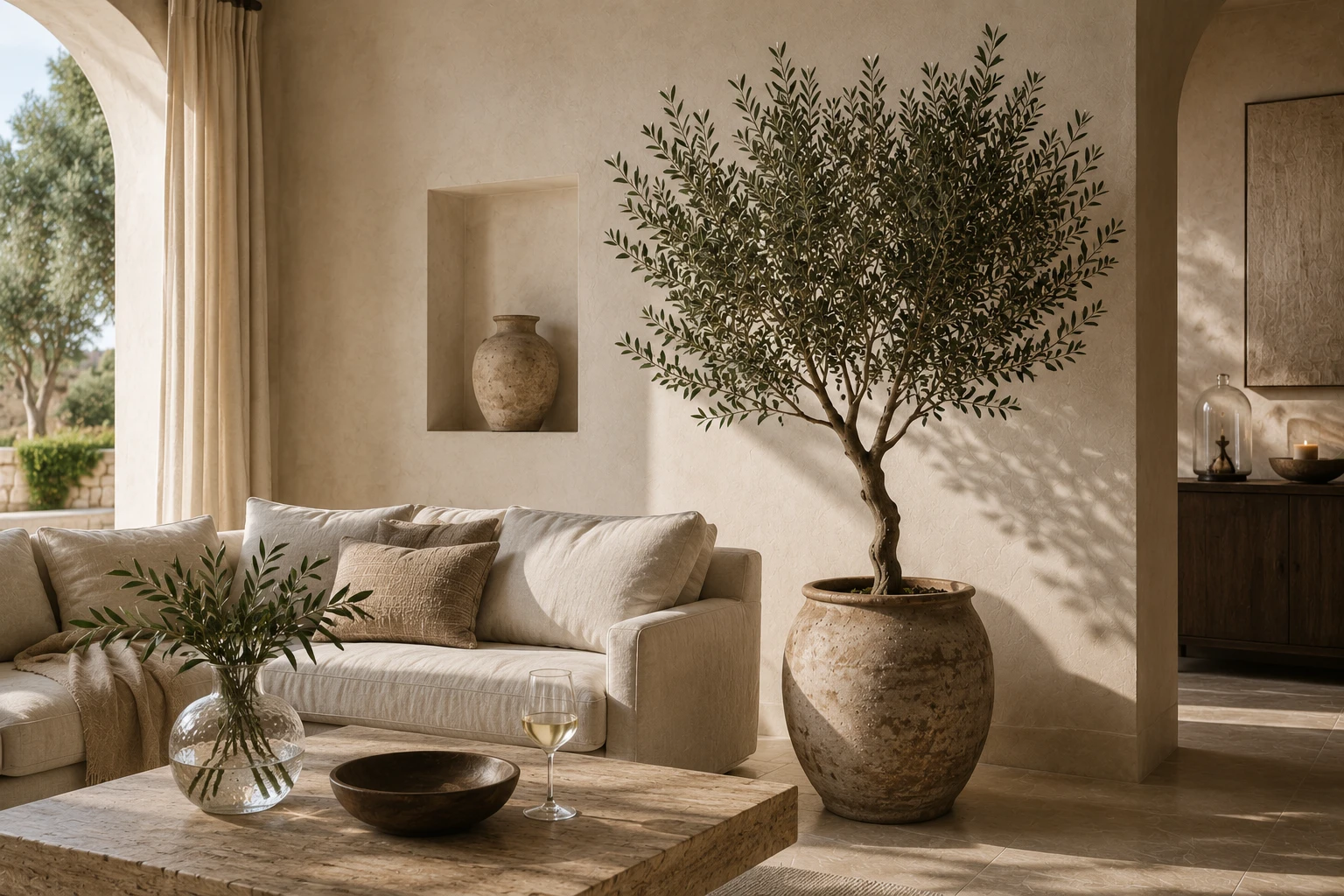
Olive trees have become one of the quiet signatures of Mediterranean interiors. Not because they are loud or decorative, but because they bring exactly the opposite: restraint, softness and a sense of age.
In a room of warm plaster, stone floors, linen curtains and natural timber, an olive tree feels completely at home. Its leaves are slim rather than lush, silvery rather than glossy, structured rather than wild. It does not dominate a space. It settles into it.
Designers return to olive trees again and again when building calm, sun-washed interiors. They add height, texture and life without disturbing the simplicity of the room.
A tree that feels architectural
The olive tree is naturally sculptural. Its branches have movement. Its trunk often has an irregular, weathered quality. Its foliage is light enough to let air and shadow pass through.
This makes it especially useful in interiors that rely on shape and material rather than color. A large olive tree can soften a blank wall, give scale to a corner, or add structure beside a sofa, console table or arched doorway.
Unlike fuller plants, an olive tree does not make a room feel busy. It creates a vertical line, a natural silhouette and a feeling of balance. In Mediterranean interiors, where beauty comes from simplicity, that matters.
Olive trees and neutral palettes
Mediterranean interiors are rarely built around sharp contrast. They tend to use softened tones: chalk, sand, stone, clay, oat, linen, warm white and muted green.
Olive trees sit naturally inside that palette. Their leaves are not a bright tropical green. They are gray-green, soft and slightly dusty in tone — a quality that works easily with limestone flooring, terracotta, aged wood, woven baskets and pale upholstery.
A glossy plant can feel too decorative in a restrained interior. An olive tree feels quieter. It brings greenery into the room without pulling the eye too aggressively.
The relationship with light
Part of the appeal is the way olive trees work with sunlight.
In a Mediterranean-style room, natural light is often one of the main design features. It moves across plaster walls, casts shadows on stone floors and changes the feeling of the space throughout the day.
Olive branches create soft, broken shadows. They do not block the light. They filter it.
Placed near a window, an olive tree makes a room feel calmer and more layered. Placed in a quiet corner, it creates the impression of softness even where the architecture is simple.
A sense of permanence
Olive trees carry history with them. Associated with old landscapes, slow growth and long life, they bring that feeling into a room even in a contemporary setting.
Permanence is part of what makes them work in considered interiors. They do not follow a fast trend. They feel established. In a world where rooms can quickly become over-styled, an olive tree suggests the space has been thought about — not overworked.
This is especially valuable in hospitality environments, where the aim is not to impress for a moment, but to create a lasting feeling.
Where they work
Olive trees are most effective where a space needs height, softness or a focal point. In a living room, they can soften the edge of a sofa or give an empty corner some structure without making the space feel crowded. In an entryway, they create an immediate sense of calm. In a hospitality setting — a lobby, a restaurant corner, a boutique hotel room — they add atmosphere while remaining refined.
Scale is everything. A small olive tree reads as decorative. A larger one reads as architectural.
Real or artificial
The Mediterranean look is associated with sun-loving plants, but not every interior has the conditions a living olive tree needs. Real specimens require strong light, careful watering and the right environment.
In darker rooms, commercial settings or interiors where consistency matters, a high-quality artificial olive tree is often the more practical choice — and the more honest one as a design decision. If the purpose is height, texture and atmosphere, placement matters more than plant care. For a closer look at how the two compare, our guide to real vs artificial olive trees covers the differences in detail.
A realistic artificial olive tree allows the look to work in spaces where a real one would struggle: shaded hallways, hotel lobbies, restaurants and rooms away from direct sun. The effect remains Mediterranean. The maintenance does not.
Styling
The most successful olive tree styling is usually simple.
Choose a planter that feels natural rather than decorative — stone, terracotta, aged ceramic, concrete or a woven material. Leave space around the tree. It should have room to breathe, not be crowded by accessories.
The surrounding materials that support it best are the ones already present in a Mediterranean room: travertine, linen, warm plaster, oak, rattan, terracotta. The goal is not to make the tree stand out. It should feel as though it has always been there.
The whole mood of the style
Olive trees define Mediterranean interiors because they carry the entire mood in one object. Natural but not wild. Elegant but not formal. Sculptural but not severe.
They work with light, texture and restraint — the three qualities that make Mediterranean interiors feel timeless. For any room trying to get there, an olive tree is one of the simplest starting points.
A few things people ask
Why are olive trees used in Mediterranean interiors?
Olive trees work in Mediterranean interiors because their character matches the aesthetic. Their leaves are gray-green, slim and slightly dusty in tone — not glossy or tropical. Their branch structure is sculptural without being formal. They bring height, texture and a sense of age without disturbing the restraint that defines Mediterranean rooms.
Where is the best place to put an olive tree in a living room?
Olive trees work well in corners, beside sofas or flanking a fireplace or doorway. The key is giving the tree room to breathe — it should not be crowded by furniture or accessories. Near a window, it can cast soft broken shadows. In a corner, it creates vertical structure. Avoid placing it where it will be seen against a busy background.
What size olive tree suits a living room?
For most living rooms, a tree between 150cm and 180cm works well — tall enough to read as a statement without overwhelming the space. Rooms with higher ceilings can carry 200cm or more. The key is proportion: the canopy should not extend wider than the seating group it sits beside. A smaller tree will read as decorative; a larger one, architectural.
Do artificial olive trees work in Mediterranean-style rooms?
Yes — a well-made artificial olive tree can hold exactly the same character as a real one in a Mediterranean-style room. The qualities that matter are the same: realistic branch structure, two-tone leaf variation, a natural taper to the trunk. For rooms without strong natural light, or in commercial and hospitality settings, an artificial tree is often the more practical choice without any loss of atmosphere.
What planter should I use with an olive tree?
Choose something that feels natural rather than decorative. Stone, terracotta, aged ceramic, concrete or woven materials all work well with the Mediterranean aesthetic. Avoid anything too shiny or polished — it tends to fight with the quiet character of the tree. The planter should feel like part of the room, not an accessory to the tree.
For a closer look at how real and artificial compare in practice, see our guide to real vs artificial olive trees. Or explore the Casa Verdant Olive Tree collection.