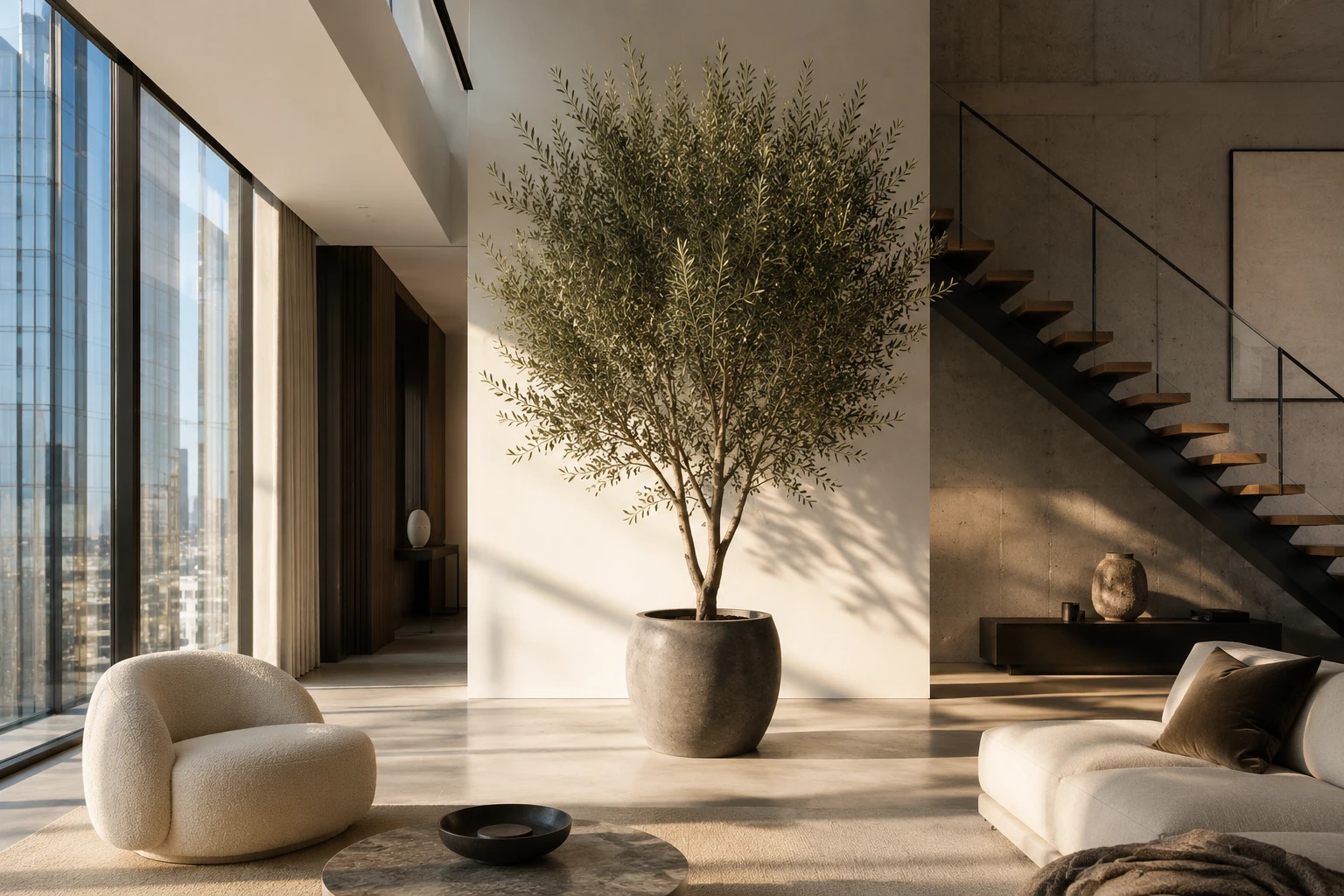
A large artificial tree can change the whole feeling of a room. It brings height, softness and structure in a way smaller plants rarely can. In the right place — beside a sofa, at the end of a hallway, in a hotel lobby — it makes a space feel complete rather than simply furnished.
But choosing a large tree is not simply a case of finding the tallest one that fits.
At six, seven or eight feet, every detail matters more. Proportion becomes more important. The planter carries more visual weight. The branch structure, trunk taper and leaf variation are far easier to notice up close. A quality issue that might pass unnoticed at four feet reads clearly at seven.
Of all large indoor trees, the olive tree is perhaps the most requested — and one of the most effective. Its slim foliage, sculptural branching and quiet Mediterranean character suit a wide range of interiors, from contemporary apartments to boutique hotels. But the principles for choosing any large artificial tree are the same.
What counts as a large artificial tree
In most interiors, a large artificial tree starts at around six feet. That is the point where the piece begins to feel architectural rather than decorative.
A six-foot tree works well in a standard living room, particularly beside a sofa, console table or reading chair. It gives height without overwhelming the space. For many homes, this is the most versatile size — and a six-foot artificial olive tree, placed in a warm stone planter, can become one of the most considered elements in a room.
A seven-foot tree feels more like a statement. It works well in rooms with generous ceiling height, open-plan layouts, entryways and corners that need presence. A seven-foot olive tree has the scale to hold a double-aspect living room or a generous hotel bedroom without effort.
An eight-foot tree or taller needs more space around it. These pieces are better suited to double-height rooms, stairwells, hotel lobbies, restaurants, showrooms and large residential interiors. Used well, they create drama. Used in a room that is too small, they can feel forced.
The goal is not to fill every inch of available height. A tree should have breathing room above it and around it. If it presses too close to the ceiling, the room can feel smaller rather than more considered.
Use ceiling height to guide the scale
A useful rule of thumb is that a tree should be roughly two-thirds of the ceiling height. It does not need to be exact, but it gives a good starting point for what will feel balanced.
In a room with an eight-foot ceiling, a five to six-foot tree usually gives the right proportion. In a nine or ten-foot room, a six to seven-foot tree tends to work well. In spaces with higher ceilings — stairwells, double-height rooms, hotel lobbies — larger trees begin to make sense and can carry the scale of the architecture properly.
The surrounding furniture also matters. A tree beside a low sofa may feel taller than the same tree placed near tall cabinetry or a fireplace. A narrow silhouette can work in a tighter space, while a wider canopy needs more room to sit comfortably without crowding the furniture around it.
Scale guide
| Room type | Best tree height | Notes |
|---|---|---|
| Standard living room, 8ft ceiling | 5ft–6ft | Good for corners, beside sofas or accent chairs |
| Larger living room, 9ft–10ft ceiling | 6ft–7ft | Stronger presence without overwhelming the space |
| Open-plan room | 7ft–8ft | Helps define zones and add visual height |
| Entryway or hallway | 6ft–7ft | Choose a slimmer silhouette if space is narrow |
| Stairwell or double-height space | 8ft+ | Needs width, visual weight and a substantial planter |
| Hotel lobby or commercial interior | 7ft–10ft+ | Scale should respond to the architecture and footfall |
Why quality matters more at larger sizes
Large artificial trees are less forgiving than small plants.
At four feet, a slightly uniform leaf shape or smooth trunk might go unnoticed. At seven feet, those details become part of the room. The tree is no longer a small accessory — it is a focal point, seen from multiple angles, in different lights, every day.
Look closely at the branch structure. It should feel slightly irregular rather than perfectly symmetrical. Real trees have movement, variation and small imperfections — branches grow into their shape over time, not outward in identical repetitions. A well-made artificial tree should carry that same quality.
The trunk is especially important at this scale. A large tree with a thin, straight or smooth trunk will usually feel wrong even if the foliage is convincing. The trunk should have taper, texture and enough visual weight to support what grows above it. For olive trees specifically, the trunk is often what makes the difference between a convincing piece and an unconvincing one — the gnarled, aged quality of a well-made olive trunk is very difficult to fake at a low price point.
Leaf variation matters throughout. Good artificial trees use subtle differences in tone, angle and density — the leaves should not all point in the same direction or carry exactly the same colour. For olive trees, the best foliage has a muted grey-green quality with slight variation between leaves, not a bright or uniform synthetic green.
The silhouette should be slightly irregular. Too perfect often reads as fake, particularly at the sizes where the tree becomes architectural.
The planter is part of the tree
A large artificial tree in an undersized or lightweight pot rarely looks convincing. The base must feel proportionate and stable — a planter that is too small makes the tree look temporary or top-heavy, regardless of how good the foliage is.
Many artificial trees arrive in a basic nursery pot suited to installation but not to the final interior. For a residential or hospitality setting, the tree should usually be placed inside a larger decorative planter that anchors the height above it and suits the room.
The material should complement the space. Stone, terracotta, aged ceramic, concrete and woven materials all work well depending on the interior. For olive trees and Mediterranean-inspired rooms, warm stone and textured ceramic tend to be especially effective — they echo the quiet character of the tree without competing with it. A shiny or overly decorative planter tends to fight against the restraint that makes a good olive tree work.
Stability matters practically as well as visually. In commercial spaces, high-traffic areas or homes with children and pets, the base should feel grounded and secure. A large tree should not be easy to knock over.
Where large artificial trees work best
Large trees are most effective where a room needs height, softness or a natural focal point.
In a living room, a large olive tree can balance a sofa group, soften a blank wall or make an empty corner feel designed. The slim, layered foliage of an olive tree adds warmth without visual weight — it brings something to the room without crowding it. A seven-foot olive tree in a warm stone planter, placed beside a linen sofa, is one of the most effective things you can do to a calm interior.
In an entryway, a tree creates atmosphere before anything else has a chance to. It gives a sense of scale and calm at the moment someone enters. An olive tree at six or seven feet is particularly well-suited to this — architectural enough to hold the space, restrained enough not to overwhelm it.
In stairwells and double-height areas, larger trees respond to the scale of the architecture in a way smaller plants cannot. A tall artificial tree gives the eye something natural to settle on in spaces that might otherwise feel cavernous or bare.
In hospitality interiors — hotel lobbies, restaurants, reception spaces — large trees do significant work. They soften hard materials, define seating areas and add warmth without the daily maintenance a living plant requires. Olive trees are among the most specified species for hospitality projects precisely because they read as both beautiful and considered. A well-placed artificial olive tree in a boutique hotel lobby can carry the entire character of the space.
Real or artificial at this scale
A large living tree can be beautiful, but it comes with real constraints. It needs the right light, careful watering, correct placement and ongoing care. The larger the tree, the more difficult it becomes to move, maintain and replace if it begins to deteriorate.
For olive trees especially, large indoor specimens are genuinely hard to source, expensive to transport and sensitive to indoor conditions. They need strong light and do not adapt well to darker rooms, inconsistent temperature or commercial environments where maintenance is limited.
A large artificial tree makes most sense when the tree is being used primarily as a design feature — when what matters is height, texture, atmosphere and permanence rather than horticulture. It allows placement where the room needs balance, not just where a living plant might survive.
The choice is not only about maintenance. It is about design control.
A few things people ask
What height artificial tree should I choose for a living room?
For most living rooms, a six to seven-foot artificial tree works well. Six feet is flexible and easy to place in rooms with standard ceiling heights. Seven feet creates more of a statement in larger rooms or spaces with nine-foot or higher ceilings.
Is a 7ft artificial tree too tall for a normal room?
For most rooms with standard eight-foot ceilings, seven feet tends to feel tall — a six-foot tree usually gives better proportion. In rooms with nine or ten-foot ceilings, seven feet works well and creates more of a statement. If ceiling height is tight, a slimmer silhouette can help more than going shorter.
What makes a large artificial tree look realistic?
The most important details are trunk texture and taper, natural branch movement, leaf variation and a slightly irregular silhouette. At larger sizes these details are more visible, so quality has a greater impact on the final result. A well-made large tree should have imperfections — no two branches identical, no leaves uniformly spaced.
Do large artificial trees need heavy planters?
Yes — visually and practically. A large tree needs a planter that feels proportionate and stable. A lightweight or undersized pot makes even a high-quality tree look temporary or top-heavy. The planter should anchor the height above it, not compete with it.
Where should I place a large artificial tree?
Large artificial trees work well in living room corners, beside sofas, in entryways, stairwells, hotel lobbies and open-plan spaces. They are most effective where a room needs height, softness or a natural focal point — and where placing a living tree would be impractical.
Casa Verdant olive trees are selected for their branch structure, natural leaf variation and proportions suited to residential and commercial interiors. Explore the Olive Tree collection, read our guide to choosing the best artificial olive tree for a living room, or see how real and artificial olive trees compare.